Comments
-
Costs of training to become a bell ringerOf course the commercial model isn't viable. We rely on the owners of buildings making them available and providing use of some expensive equipment for free, although we might contribute towards the upkeep of the latter. However it's interesting to consider what other inputs such as volunteer time are required to teach someone to ring. We can then consider whether we are making best use of scarce resources.
The model that I costed is based on the typical Guild/Association training day. However in 2 x 2 hour slots each pupil only gets 6 - 8 five minute touches of quality rope time. They may benefit form more practice in their own tower, but in my experience the majority come because they can't do what they want to learn in their own tower, and as these training days are often once a year, they are likely to come back to the same group next year (if they haven't given up in the mean time!).
The Hereford/Bradfield/Essex/NW ringing courses use a similar model, providing around three times as much quality rope time in around six or more sessions concentrated over three/four days. Whilst far less is forgotten between sessions, you probably need to go on two of these courses to to turn a call change ringer who rings with a weak local band into someone who can confidently hunt the treble to QP standard, or progress from this to ringing their first QP inside etc.
The longer courses at the Tulloch Ringing Centre, which make good use of simulators etc is pretty close to the ideal, and people are willing to travel there and pay, but it is not something that could be rolled out everywhere. However the Birmingham School and Bell Ringing and the Mancroft Ringing Discovery Centre are models that could be adapted for use elsewhere, but they do rely on the use of existing facilities and investment to improve them, which are not reflected in their charges.
A much smarter way of making best use of scarce resources would be to use these training days and courses to promote the use of some simple exercises to break down the learning process into easily manageable steps. Those who come from weak bands can then take them back to their own towers to help improve the tuition for the others there. -
Costs of training to become a bell ringerI've given this a little more thought as we've not yet got stuck into Level 3. I do know that the Birmingham School of bell ringing reckons that it takes between one or two terms to progress from one Level to the next. Let's say 15 weeks of two hour sessions with five experienced ringers, and one teacher/leader/stander behind. They could give each of a group of five 'learners' at least three 5 minute touches of quality rope time in each weekly session. In time two learners might be able to ring in the same touch, increasing the amount of rope time, but there would still be a need for the same number of helpers, to stand behind and provide feedback.
Based on my previous figures that's about 180 hours of teacher/helper time for 5 pupils = £720 per pupil per Level. Add on incidental expenses that's probably in excess of £800 per pupil per level.
That's around £3,200 to get to Level 5. -
Costs of training to become a bell ringerWe seem to have drifted a little off topic. To get back on topic, I estimate that it costs over £400 to teach someone to Level 1 of learning the Ropes and £200 for each level thereafter. Therefore to get to Level 5, which is a fairly ‘basic’ standard for a method ringer therefore costs about £1,200 per ringer
A year ago we held a recruitment event at the Cheriton parish fete with the Charmborough Ring. This cost £150 to hire. Plus a little more for transport. We also printed some handouts. We held a taster evening a couple of weeks later and as a result a group of six started to learn. Over the following weeks more joined and we ended up teaching 13 people to handle. We started with a month of intensive handling lessons, with each pupil receiving a series of one hour lessons 1:1 with an instructor. These were scheduled using Doodle Polls and took place several afternoons and evenings in these first few weeks. In total each pupil received on average 12 handling lessons to get to Level 1, most receiving two a week for the first four weeks, although the handling lessons continued for some time afterwards in parallel with learning to ring rounds, and also as more friends joined the group. However, we also lost three of the group over this period, so we ended up with ten new ringers.
To deliver this instruction we had a team of six handling instructors who volunteered to give up their time, some of whom were travelling up to 15 miles to each session, although the average distance was about 7.5 miles. The National Lottery credits volunteer time at £20 per hour and the marginal inland revenue mileage rate is 25p/mile. We also bought each new recruit a Learning the Ropes Personal Progress Logbook at £2.50 each. There were also a couple of cracked stays. Therefore the volunteer time came to £3,120, plus travelling expenses of £585. Including incidentals. The total cost to reach Level 1 of learning the Ropes was about £4,000 or £400 per learner who reached Level 1.
The Winchester District did buy some simulator sensors at a cost of £420 and another ringer loaned a second-hand laptop. There is also the cost of training the teachers. Four of the instructors had previously attended an ART Module 1 teacher training course, although there were two very competent teachers who had not, and everyone worked together well. If you include a portion of these costs, the actual cost is higher than £400 per ringer.
Some of the band rang some good rounds for the Carol service and we then had six weeks off for Omicron. To date we have held about 40 weekly practices and the band is now ringing for some services (because it is part of a large benefice, service times vary from week to week and sometimes there are no Sunday services to ring for) and weddings to rounds and call changes standard (Level 2 of Learning the Ropes) almost entirely on their own. We have been fortunate to be joined by two lapsed ringers living in the village, and four helpers have been coming each week, although the need for this involvement is gradually tailing off. We still have some handling practice for the stragglers before the main practice, and use the simulator as well, but our helpers are not the same group as the handling instructors, so the average travelling distance is about 5 miles. We’ve also given each new ringer the publication A Ringers Guide to Learning the Ropes at £7.50 each, plus another couple of cracked stays (the trebles are very light and flighty, with a high ceiling, and that is something we need to fix by purchasing some rope guides). However, the cost of reaching Level 2 for the ten ringers is going to work out at around £200 each.
We’ve just started on Level 3 for the most advanced members of the group, so rather than tailing off, we’re going to need to retain our helpers for the next and subsequent stages, at a similar level of input for each level. The problem is that with such a large group of rounds and call-change ringers, we can’t teach all of them to plain hunt at the same time, otherwise they will get so little rope time that they forget everything between lessons. Therefore we’re going to need to establish a second practice night, possibly at another silent tower nearby (but that means more travelling) or send some of them away on training days (the Guild has an annual one) and longer courses, but that has a cost too.
Fortunately the learners are far more willing to pay for this tuition than the typical ringer who has been ringing far longer. Although we have not charged, my wine cellar and that of my fellow teachers has been kept generously stocked!!! -
Costs of training to become a bell ringerI was a helper on the new NW Ringing course a couple of weeks ago. What was interesting was that each student was willing to pay £275 for two and half days intensive tuition in their chosen subject. What was disappointing was that each student in my group (and I suspect many of the others) came because they met a barrier to their progress in their own tower, and even after the course, they would have very limited opportunities to ring their chosen method afterwards.
After the course the organisers set up a WhatsApp group for us all to keep in touch. In my feedback I suggested that as there are other similar courses (Hereford, Essex, Bradfield etc) what would be useful would be to link up with them and set up regional WhatsApp groups for each of the subjects, so that students could get together with other like minded people and practice what they were learning on the course. Even as I helper I wouldn't mind joining in for a follow up day later in the year in my part of the country, perhaps with a few quarter peal attempts thrown in. I also suspect others who had not been on the course would be interested in joining in too.
ART has just held its second successful Learning the Ropes day for people at the lower end, but wouldn't this be a good way of harnessing new ways of working to help remove the barriers for people further up the ladder? -
Costs of training to become a bell ringerIn the W&P we have a 'Probationary' category of membership for new ringers. In 2019 we carried out a survey of the membership, which included looking at the progression of the probationary members. Of those who were probationary members in 2015, 49% ceased membership in 2016 and a further 12% in 2017. Only 34% became Full members. The survey also showed that a third (33%) of the Guild's members are either learning to handle, ring rounds and call changes, or plain hunt. Clearly there is not only a tremendous wastage, but also a need for far more investment in training at the foundation skills level to improve retention rates. However, nationally there are several millions of pounds sitting in restoration funds for years on end, at very low interest rates, when inflation this year is forecast to to reach 13%. We seem to have too many bells and not enough ringers. If only we could re-assess the priorities and change the culture!
Guild Education Survey Results and Feedback | WPBELLS -
Guild and society eventsWe achieved this by:
- At Cheriton we had the active support and encouragement of the vicar. We have also been invited to meet the other clergy in the Deanery at a breakfast meeting to discuss how we could help other villages in a similar way and this be reflected in their action plans. Districts and Branches are often very inward looking and have limited contact with the church structures in their area.
- We used the Charmborough Ring at the Parish Fete. Five people left their contact details. We contacted them afterwards and fixed up a 'taster' evening. (too often ringers wait for prospective learners to get back in touch, or just turn up at a practice, but they rarely do. It's about showing an interest in the learner, personal contact and making them feel wanted).
- We followed the taster evening up with three weeks of intensive bell-handling sessions. We had the support of two very experienced peal ringers from other towers in the South of the District (one has rung over 3,000 peals) but neither are ART members, and we are not pushing them to be, but they are very good at teaching bell-handling. In my experience many excellent ringers are only too willing to help, provided that the teaching is done in a structured way.
- We were able to give each pupil two or more one-hour handling lessons with an instructor in the first few weeks. They all had 6 - 8 hours 'rope time'.
- During the first few weeks several more people came forward to learn. They were either friends of the others, or found out through our posts on the village Facebook group
- Around half the pupils were early retired, semi-retired or working from home, so we were able to offer afternoon as well as evening handling sessions. We used Doodle Polls and Google forms to check availability and fix these up.
- We also used the colourful A5 CCCBR flyer with pictures of young people on it. This caught the attention of two teenagers in the village (they soon caught the adults up!).
- We have lost three of the learners, but have taken the trouble to find out why. One was a medical issue, another changed jobs and could no longer come. A third was just too busy and couldn't make many of the practices, and they didn't want to waste our time.
- We have concentrated on good bell-handling and developing listening skills first. Also the concept of knowing which place you are ringing in. We are letting people learn at their own pace and getting the basics right, instead of pushing them too early into method ringing. It takes far longer to un-learn something and then get it right.
- We are in the fortunate that at New Alresford just up the road we have a band that can ring Cambridge Minor, Stedman Triples etc. We need to be careful not to dilute the practices there with a large influx of learners, so we are holding sessions focussed at different levels at different times (Beginners, Improvers, Intermediate, Advanced). Our experienced ringers are helping out with the learners, and the learners are comfortable with visiting neighbouring towers for sessions. We are also developing good social links between both groups of ringers. This is all something which would work less well on a larger scale, such as the District.
- At Cheriton we had the active support and encouragement of the vicar. We have also been invited to meet the other clergy in the Deanery at a breakfast meeting to discuss how we could help other villages in a similar way and this be reflected in their action plans. Districts and Branches are often very inward looking and have limited contact with the church structures in their area.
-
Guild and society eventsThat's not what I was advocating. The local District is quite large (34 towers with 4 or more bells) and covers a large area. It can take over 45 minutes to travel from one end to the other by car. There are several large towns and a city with active bands capable of ringing surprise, and rings of 8, 10, 12 and 14. They might be down a few ringers, but can still ring surprise.
However the northern half of the District is more rural in character and consists mainly of 5's and 6's. It's no good holding 'all welcome' practices as the standards of competence is world's apart. In my corner of the District we are concentrating on the twelve towers in the Deanery, and that is a perfectly viable building block (so long as we are not trying to hold surprise practices, striking competitions, Saturday afternoon meetings, annual training days etc.).
There is a lot of enthusiasm amongst the new ringers and I fear that this would be dampened down if what were trying to do needed to be at District level. The new ringers might only be ringing call-changes and plain hunt now, but I am sure that quite a few will be ringing surprise in a couple of years, and several currently silent or near silent towers will have their own local bands -
Guild and society eventsSome Districts are active, but these were the more active ones before Covid. Others, particularly the more rural ones are struggling. At tower level a number of the rural towers round here have lost key personnel, and those left are content to ring three (in a six bell tower) on Sundays. They have no one to teach new ringers, and these towers now increasingly rely on social media to source ready made ringers for weddings and special services. As parishes are amalgamated into larger benefices and clergy numbers fall, Sunday services are becoming less frequent. It is not unusual in some cases round here to just have one Sunday service a month to ring for. It therefore seems that in the long term local bands ringing at these more rural towers will die out.
At Guild and District level numbers have fallen, and it has proved difficult to find bands to enter striking competitions. It seems that the more experienced ringers are being more choosy on what they do with their time. As an ART Tutor I have also delivered a number of ART Module 1 courses (how to teach bell handling) since Covid. It is noticeable that most of those attending are keen to learn to teach, or are inexperienced teachers who are keen to improve their skills, but this is not matched by the number of experienced teachers who are willing to support and mentor these delegates in the period after the day course. This is essential to help the delegates gain experience and complete their logbooks. If societies don't build on the enthusiasm and train new teachers and tower captains, it's not going to help with the recovery.
I fear that post Covid, ringing will increasingly become concentrated on fewer towers in the larger towns and villages, and the trend for the more ringing to take place outside the traditional structures and Saturday afternoon meetings will continue. The traditional culture is still quite strong and I suspect that its supporters will continue to struggle on and resist meaningful change and improvements. They will be missing out.
Round here we have re-activated a silent tower in a large village over the last nine months. They now have a band of twelve ringers aged 12 - 65, the more advanced of whom are just starting to plain hunt. They are very keen and we have held a number of social events. They have also gone out to ring at some of the other neighbouring towers and we are talking to the local school about using the tower's large set of handbells for tune-ringing.
Whilst a couple of District members helped with intensive teaching of bell-handling in the first few months and we persuaded the District to buy a portable simulator, there has been limited involvement from the District. Practices focussed on methods up to Cambridge Minor and the Standard eight, striking competitions against 'expert bands' and quarterly meetings over half an hour's drive away are of little interest to this band. We have just started holding regular 'Improvers' practices (call changes, kaleidoscope and plain hunt) focussed on this group and others in our local Deanery, and they have proved very popular. By being regular, local and sociable, they will make faster progress than the usual annual training day.
It's adapting to retain the interest of keen new ringers like this that the exercise desperately needs, rather than things returning to the old 'normal'. -
Survey of Ringing 1988I have also uploaded a copy of the 1972 survey here: www.bellringing.co.uk/1972 Survey.pdf
The two reports side by side make very interesting reading. One thing that stands out to me is table 1 where it was estimated that in 1972 10% of all towers were unringable or unsafe. This included 3.9% of eight bell towers; 8.0% of six bell towers and 23.3% of five bell towers. Having just checked on Dove, today's figures are 2.1% of eight bell towers; 2.2% of six bell towers and 22.0% of five bell towers.
When you take into account all the augmentations that have take place since 1972, our stock of ringable towers are in far better condition than they were in 1972. This is mainly due to the support from BRF's, the Millennium commission and the vast amounts of volunteer labour ploughed in. However with an ageing workforce are we going to be able to continue doing this? Also, the vast bulk of unringable towers are 3's, 4's and 5's. Is it sensible to focus the lions share of our resources on these towers, when the problems going forward are going to be parish finances and the number of active ringers per ringable bell? -
Survey of Ringing 1988There is a pdf copy of the 1988 report available online at www.bellringing.co.uk/1988 survey.pdf
-
Insurance when ringingBoth of the scenarios that you paint are somewhat extreme, but are the sort of thing that lead societies take out some form of insurance. However, as we have seen above although members in all four Guilds and Associations above are “insured” in practice whether they are covered, or not, will depend on what the incident is and which policy is in place. And, even if it is covered, the amount that can be claimed will vary significantly. Also, it may already be covered by another policy (e.g. the PCC's) and it is fraudulent to claim against more than one policy for the same incident.
There are many different insurance products available in the marketplace, but many ringers do not appreciate the differences. There is some excellent advice on the SMWG website, but it is not easy to find. https://cccbr.org.uk/wp-content/uploads/2021/01/Insurance-v3.pdf . However, as I explained in my earlier posting, you really need to start with an understanding of property law and the potential hazards, and then undertake a risk assessment.
You need to consider who has a ‘duty of care’ and who has been negligent – Donahue V Stevenson (the snail in the Ginger Beer case). In your example of the learner, would it be reasonable to expect you as a visitor to have such a wide duty of care? wasn’t the tower captain who asked you to supervise a learner negligent?; or was it the person who taught the learner to ring in the first place?; or the PCC in not having a competent tower captain or teacher? Whilst the learner could try and sue you, they would stand more success suing the PCC, who have a duty of care towards their ringers and should be insured to cover this risk. The PCC should also protect you as a visitor, who has permission to be there.
Similarly, if the gudgeon breaks rather than the stay, this tends to indicate a problem with the gudgeon itself. Has it been machined correctly (bell-hangers duty of care) or has the steeple-keeper fitted an over-sized replacement stay? What system is in place to ensure that the steeple-keeper has been trained properly?
As the SMWG advice explains, the situations that you suggest are extremely rare and who is responsible can be extremely complicated. In both cases the PCC (or building owner in the case of a secular building) have duties of care. Normally they will have Employers Liability Insurance to cover their own ringers, and Public Liability Insurance to cover damage by visitors, who have permission to be there. Sometimes, depending on what insurance is in place, your Guild or Association Insurance may cover these incidents as well. Therefore, if you are not personally insured, why would someone bother to sue you, unless you have been reckless, ignored those in charge, and rung without permission. -
Insurance when ringingI think the vast majority of ringers totally misunderstand insurance for ringing and ringers, and many Guilds and Associations spend significant sums of money unnecessarily. Marcus Booth of Ecclesiastical gave an excellent presentation at the ART Conference a few years ago, and a recording is available on ART’s YouTube channel. The presentation was repeated at the CCCBR Roadshow at Goldsmiths.
I am not an insurer, but my experience comes from the other side of the fence. Rather than start by arranging a policy I think it is important for ringers to start by considering the risks and undertaking a risk assessment.
Typical situations could be:
1. Jane a member of the Sunday band at Little Snoring slips down the worn tower steps after Sunday morning ringing. There is no handrail or rope to hold on to, so she falls a long way and breaks several bones. The worn steps have previously been reported to the PCC, but no action has been taken.
2. John the steeplekeeper at Little Snoring needs to check the ropes in his tower for wear. He goes up alone and without a mobile phone and slips off the frame and seriously injures himself. It is many hours before he is found and as a consequence of the delay and his injuries he has to take significant time off work.
3. There is a tall vertical wooden ladder up the bells at Little Snoring, without any hoops or a fall arrest system. The top of the ladder is over 16 feet high above a stone floor and a ringer falls off while attempting to lift the heavy trap door at the top, and is seriously injured. There is no risk assessment in place for use of the ladder, or any routine inspection of it.
4. Peter, a member of the local band at Little Snoring, is electrocuted and dies when switching off a faulty fan heater after practice. No PAT testing regime is in place.
5. John the steeplekeeper is concerned that pigeons have got in to the tower. After replacing the wire netting he removes the pigeon droppings and disposes them. A few days later he becomes seriously ill. No guidance or PPE has been provided by the PCC.
6. James, another member of the local band rings up the tenor on practice night. Unbeknown to the ringers the Vicar (or churchwarden) has let telecomms engineers up the tower. They climbed up the ladder past the tenor and dislodged the slider as they hoisted up their equipment. As they were not ringers they did not know to replace it. No one checked after their visit. James is relatively tall and it is a heavy bell and he had not let the last coil out, when the bell was up. As a consequence when he tried to set the bell, James was lifted several feet into the air and fell awkwardly, breaking several bones, as well as receiving rope burns.
None of these are Guild or Association events. The point I am making is that the PCC have duties under the Health & Safety at Work Act which include the provision of:
a. a safe system of work;
b. a safe place of work.
In addition, the PCC have duties under other legislation and common law.
Therefore, they usually have Employers Liability Insurance, typically with £5 or £10 million cover. As Marcus explained in his presentation, although ‘volunteers’ members of the local band will be treated as ‘employees’ and covered by the PCC’s insurance. In addition, the PCC will also have Public Liability Insurance, which will cover visiting ringers, and other people who could be expected to visit the church (e.g. guests at a wedding).
Therefore Guilds and Association with their own cover might be able to claim against this, but there is usually a clause saying that they will only be covered if there is no other insurance in place. If any of these incidents happened the insurers would then make a claim against the PCC.
Therefore in effect Guild and Association Insurance only covers incidents at Guild and Association events, and for which the Guild and Association is responsible – e.g. despite being warned not to do so, someone lets off the clock-hammers whilst the bells are still swinging and this smashes some wheels and cracks a bell.
Some Guilds and Associations also have personal accident insurance, but this is very expensive and the benefits are very low. £20,000 for a death would not cover the mortgage payments for a young person who is the main breadwinner for a family. As people’s personal financial circumstance vary significantly it is better that they have their own personal accident cover (and many do already).
The Sufffolk Guild paid £390.36 for Members Accident Insurance (up to £5k) and £347.03 for Public Liability Insurance and £103.60 for Property Damage insurance in 2021 InsuranceSummary20201006.pdf (<a href="http://suffolkbells.org.uk" target="_blank" rel="nofollow">suffolkbells.org.uk</a>)
The MCA&LDG Paid £1,045 for Personal Accident Insurance (up to (£20k) in 2021. It does not hold Public Liability Insurance Insurance (bellringing.london)
The Surrey Association paid £533.99 for £1m of Public Liability Insurance in 2021 but holds no Personal Accident Insurance Insurance - The Surrey Association of church bell ringers (surreybellringers.org.uk)
The Gloucester & Bristol DA paid £489 in 2021 so that the Association - and its paid up members as individuals - are insured for £2,000,000 against third party claims for being negligent whilst acting as G&B members. Members are NOT insured against personal injury at all… …they would need to check this with their own PCC. Association Information (bellsgandb.org.uk)
This information is all available with a simple Google search. It demonstrates that there are vast differences between what societies pay and what is covered.
Completing this exercise and comparing all societies would be a very useful exercise and help societies improve value for money for their members. -
The Median RingerWe could have the coaches. The total number of course delegates who have attended ART Teacher Training Modules since the 2012 is 4,050 as at the end of 2020. Demand for these modules is as high as ever, with ART on track to deliver a further 50 Modules in 2020 with an average attendance of ten delegates per Module.
Having delivered a number of these Modules as an ART Tutor, it has been interesting to observe what happens afterwards. Delegates are keen to learn teach or improve their teaching skills, but often the experienced teachers who could mentor them and help them to gain practical teaching experience do not do this. There seems to be passive aggressive resistance at all levels. Society education & training committees and PR officers who deal with web enquiries, seem to prefer to place new recruits with an existing 'known' teacher, rather than a trainee teacher. I know of examples where a recruit has been sent to a tower some distance away to learn, despite the fact that there is a potentially very good new teacher nearby. There is no a joined up strategy.
Also, there are examples of where Old Fred who has been teaching 'his' way for many years is not happy that young Jenny, who has been on an ART Module and understands that teaching needs to be flexible and suit the pupils style of learning, is open to different ways of doing things, so Jenny never gets the opportunity to teach.
When ART was established ten years ago, there was a lot of criticism from certain quarters that it would lead to many experienced teachers giving up teaching. However, if they have it is probably due to old age. What the exercise needs to do at all levels now is to adopt a much more supportive attitude to the 4,000 who have come on a teacher training Module in the last ten years, and the 500 odd who will attend this year. It's almost one per tower and if properly supported and brought on these people could help safeguard the future health of the exercise. -
The Median RingerOver the next decade, I suspect that as so many of us are in the over 60 bulge, that either the 30% will increase, or that as a significant number will no longer be with us, unless they are replaced at the same rate, total membership will steadily go down.
-
The Median RingerI am sure that everyone will want to collect the basic data anyway, the point that I was making was that it was all the other stuff in the 1988 survey which is very interesting and will provoke debate on how things have changed and what we need to do going forward.
However I think we do need to be careful to define what is meant by an 'active' ringer. We may have 30,000 or possibly even 40,000 'ringers', but how often do they ring? From my experience I suspect that there are quite a few 'ringers' listed in annual reports, who have their membership paid for them, even though that have been living in a care home for a year or more. At the other extreme is someone who has had a few handling lessons, or someone who hasn't come for a couple of months, to be counted in the overall total? -
The Median RingerI like Graham John's suggestion. Some form of CCCBR template for societies to use would enable them to conduct (and update) local surveys of the state of ringing in their area, and perhaps put an action plan together. There would also be consistency between the data. Is this something that Paul Wotton and the V&L Group could organise?
I think we have a reasonable consensus on the the number of ringers, the demographic profile, what methods are rung at practices and on Sunday, the numbers of silent towers and struggling bands, and where this is all leading us. However the 1988 survey (http://bellringing.co.uk/1988%20survey.pdf) included a whole lot more information which if updated would help Guilds and Associations and Districts and Branches and the CCCBR to do something to address the trends.
- The relationship between ringers and the church (today Evangelical churches are in the ascendancy and we need to understand the impact of this)
- Teaching the art - tower captains
- Recruitment and retention rates
- Publications (today things are much different and we are heading for everything to be on line)
- Ringing courses - preferred topics
- Effectiveness of Guilds and Associations
- Grass roots - how Districts and Branches are regarded by their members
- Care of bells (besides restoration, ought to include how welcoming the ringing environment is)
- Regional variations
- Effect of settlement size
- Sociological profile (today would include BME participation and inclusivity data and relate this to the local community)
- Itinerant bands (today would include clusters, hubs etc)
- The Ringing World (today would include various forms of communication)
We need to be clear that we are not undertaking a census. A 10% sample, as in 1988, or less would be adequate, provided that participants were chosen at random. There are statistical techniques for verifying randomness.
Also one large survey form as in 1988 would take too long for participants to complete. A suite of more focused on-line surveys would be better, and this would enable them to be developed and issued over time, rather than have to wait. -
The Median RingerI think the problem is that the gap between the top and bottom ends of ringing has widened significantly during my 50 year ringing career. There is now a 'squeezed middle' which makes it difficult for many to progress up the ladder or pyramid beyond LtR3, unless you happen to be lucky enough to ring at one of those towers with a competent band.
The fragmented communication structure of the exercise and a number of individuals who hold positions of influence and resist change (and who have been in post a long time), also makes it difficult to address current issues and move forward. We need more new leaders but with the squeezed middle there are few candidates willing to come forward.
There was a comprehensive survey of the state of ringing in 1988 which if replicated today would help move the debate forward. Although some work was also undertaken in the early 2000's which helps identify what towers ring on practice night (if they hold one) and confirms that a large number of bands do not ring much more than PB and Grandsire, it's a shame that a more comprehensive survey has not been undertaken, especially as modern technology makes this far easier than 1988.
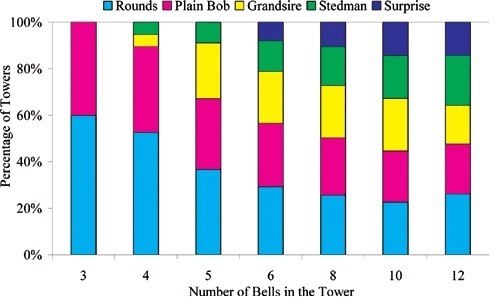
2004 Survey
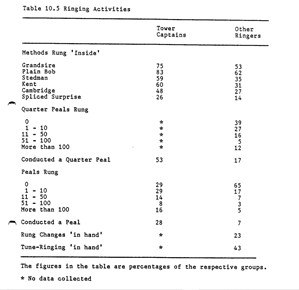
1988 Survey extract -
The Median RingerAlthough Gordon Lucas published his book in 2004, dodging and place making exercises are included in the 'One per Learner' books first published by the late Pam Copson in 1982. Kaleidoscope is just a development of this. There are also a number of other bell control exercises common to the OPL 'Bell Club Awards' and ART's 'Learning the Ropes' scheme.
-
Sound levels outsideYou need to be very careful in quoting dB as it is a logarithmic scale and you can't simply add the figures of two sounds together. To be useful you also need to give the distance from the source. There are also different weighted scales to consider as the sound of bells is not constant - the bell is at its loudest when it strikes. For construction site noise Town Planners consider a time weighted scale over a period of hours.
However most noise complaints about bells are made to the Environmental Health Officer and considered under the law of nuisance, and that depends on what is 'reasonable'. I was once involved in a case where neighbours in a block of flats were making a lot of noise. One neighbour was elderly and as they were hard of hearing it didn't affect them. However it seriously affected the neighbour who worked shifts and wanted to sleep! -
Keeping Churches OpenI'm not even sure that the inspecting Architect or Surveyor would spot many of the issues that an experienced steeple-keeper would spot. The problem is that many ringers are now quite old, and there are less people with the energy and skills to go out and look after these towers. Some Guilds and Associations are contributing towards periodic maintenance inspections by a professional bell-hanger. Several of these can be undertaken in the same area in the same day, making this relatively inexpensive. However, as with the other issues, it comes down to the ringing community needing to make a reasonable financial contribution in future.
Roger Booth

Start FollowingSend a Message
- Contact Us
- RingingForums Policy
- Terms of Service
- Useful Hints and Tips
- Sign In
- © 2026 Ringing Forums