-
Forthcoming CCCBR Ringing CensusIf you mean a DMO, I’ve seen somewhere recently (maybe Exec minutes) that a group had even set up to look at it. Let’s hope they get further than the 2014 group did. — John Harrison
Not just a direct membership organisation (DMO) but there were other recommendations too. One was to substantially reduce the size of the Council, to facilitate greater scrutiny of the Executive and Workgroups.
Instead, the format of the meeting has changed, allowing less time for this scrutiny, I note that at this year's AGM only 162 representatives were present, whereas 20 years ago it was 209, so it seems that there is now less interest in the Council's work. Let's hope that the census raises the profile of the Council and promotes informed debate at both local and national level about the challenges facing us . -
Forthcoming CCCBR Ringing CensusIt seems that certain CCCBR reps and various 'gatekeepers' in the cascade chain aren't passing information down to the ringers at grass roots level. If there's a problem now, it's going to be worse in just over three weeks time, when these grass roots ringers need to receive the link and will only have a fortnight to respond. Poor communication in parts of the exercise is a major issue hindering us moving forward, and just perpetuates the status quo. It's a shame that CRAG's recommendations were never fully explored.
-
Contacting neighbours ahead of a ringing event - template or exampleOne of our ringers posts articles and attractive videos and photos most weeks on our ringers Facebook page, and she then shares quite a few of them with the town Facebook group, which reaches over 7,500 people (50% more than the population of the town), and they get a lot of likes. For example she did this for SEECON. Posting before, during and after your contest could generate a lot of positive publicity. We've also found Gemma Groom's video with tips on growing your social media presence very helpful https://www.youtube.com/watch?v=u_S9yKruPTI&t=7s
-
Learn to ring enquiriesIt's not just the stand-alone BRF's. Even the societies where the whole society is a registered charity are accumulating funds faster than they spend them:
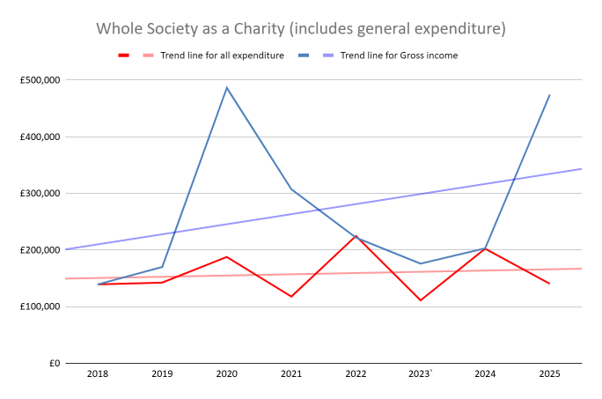
The large blip in 2020 is the Essex Association, who subsequently surveyed their members about what to do with the bequests, with some interesting results: https://eacr.org.uk/wp-content/uploads/2024/07/survey-feedback.pdf -
Learn to ring enquirieswould you be prepared to share this data with me please? — Jason Carter
I have given you (and anyone else interested) view only access to the spreadsheet with this link https://docs.google.com/spreadsheets/d/1ouvd87QC_NLNu-Pclb1IirDMspbpx2c_/edit?usp=sharing&ouid=107676497967833956904&rtpof=true&sd=true
The returns from each society published on the Charity Commission website is hyperlinked, so all you need to do is click on the hyperlink to find out more.
To be clear, I am not suggesting that we should dictate where people leave their money to, as that is their choice. Nor am I suggesting that the CCCBR should 'steal' the money raised by Guilds and Associations, but what I am suggesting is that Guilds and Associations should be thinking seriously about what they should be doing with all this money that is accumulating, and with more bequests in the pipeline, likely to accumulate even faster.
Converting to the whole society being a charity to provide greater flexibility, giving larger grants, widening the scope of what will be paid for, rejuvenating unwelcoming ringing chambers, setting up more teaching centres, there are all sorts of possibilites for worthwhile use of all this money which is already sitting there and slowly depreciating.
In 1996 there were 5.3 years worth of funds held by societies in reserve, without any more money coming in. Now many Guilds and Associations hold 10 or 15 years in reserve, sometimes more. What is also worrying is that whilst a small number of societies, notably Oxford and Coventry have money invested for long term returns, and I have no problem with this, a lot of societies have their most if not all their money held in short term deposit accounts, notably the CBF Church of England Board of Finance Deposit Fund, which is currently giving a competitive rate of interest at 3.93% AER. However over the last 10 years funds invested here would have grown by 21.24% whereas CPI inflation was 41.65% https://www.ccla.co.uk/documents/cbf-church-england-deposit-fund-fact-sheet/download?inline
Many ringers are pensioners, or saving for their retirement. I am sure that any IFA would not advise them to hold substantial funds, which are not required for some time, in a short term deposit account! -
Learn to ring enquiriesit remains the case that Australian and New Zealand ringers are dumbfounded by the quantity of cash in England tied up in BRFs and the like (you have more than enough bells) but which is not made available for the more human side of ringing (training, recruitment etc) which is where the need lies. — David Smith
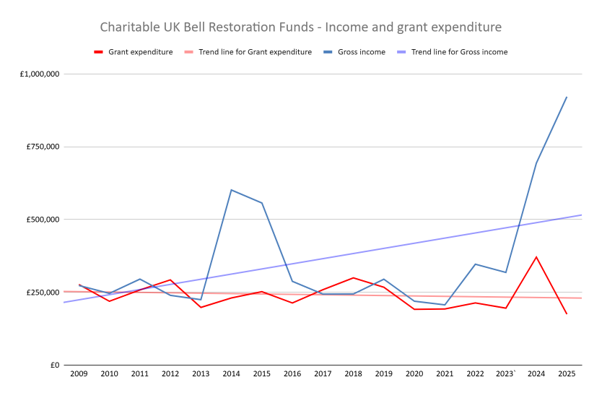
Agreed. Since 2009 when I was a Director of the Ringing Foundation, I have been keeping track, via the Charity Commission website, of income and expenditure into charitable BRF's and also those Societies where the whole society is a registered charity. It is evident that with current demographics a lot of money is being left to societies in bequests, and much more is probably on the way.
There are 30 Societies where just the BRF is a registered charity and so far 20 of these have submitted their annual return for 2025. These 20 raised £921k for their BRF's in 2025, much of it in the form of bequests. However the amount paid out in grants from the 30 with stand-alone BRF's has remained relatively static since 2019, so has fallen in real terms. The current average is around £250k per annum.
In addition to this the Suffolk Guild (where the whole society is a registered charity) received a bequest of £267k specifically for augmentations to 8 or more, and the CCCBR itself also received a £67k bequest specifically for bell work to bells in Bedford.
I am not saying that we should dictate where people leave their money to, that is their choice, but there is a need for a publicity campaign from the CCCBR so that people are able to make better informed choices.
At a time when the CCCBR's regular income is less than £40k per annum, and we have far more bells than ringers to ring them, does this make sense? How is a recruitment portal going to operate if secure funding is not available to pay someone to operate it and respond in a timely manner to enquiries? let alone all the other things that could be done with this surplus funding?
-
Learn to ring enquiriesI also think we need qualitative research / input as stats like the decline in peal ringing don’t answer the ‘why’ — Lucy Chandhial
There's plenty of data to demonstrate 'what' has been happening over the past few decades. I'm not sure that we're ever going to get a clear answer to 'why' as there are a lot of different factors at play, and ringers being ringers we're never going to agree. It's a bit like global warming and there are still quite a few deniers.
The important questions are 'what' needs to be done, 'how' we are going to do it and ''where' should we focus our efforts.
I am wary of the weight of expectation on younger ringers. — Lucy Chandhial
We could make a big impact by encouraging those in leadership positions to delegate far more. Many of the older tower captains and society officers try to do everything themselves. The job grows, they become a very difficult act to follow, and so stay in post. However the Sherborne Teaching Aids 'One per Learner' book and 'Bell Club' encourages new ringers to learn to conduct call changes, conduct a 120, help with steeplekeeping, and write an article etc. ART's 'Learning the Ropes' scheme and '50 Ringing Things Challenge' takes this even further forward.
If there was a change in culture, with far more delegation and many more people encouraged to contribute in small ways, starting like this, there would far less load on any one person's shoulders. Rather than assume anything, perhaps we could survey some younger ringers to find out whether they would welcome being more involved in some small way. I suspect that they would, and it would also contribute to their enjoyment of ringing.
Of course, some of the people currently in positions of authority will be afraid of letting go, and the new people will make mistakes. However the existing post holders need to remain in the background and provide encouragement and support when needed. Regular changes will then bring new life to towers and societies. -
Learn to ring enquiriesA couple of older ringers have told me that they think the origin of today’s problem is the people who learnt in the 1970’s and made little effort to teach or recruit for their whole ringing career. — Lucy Chandhial
If a survey in 1988 found 20-40 year olds were the most successful tower captains could those 60-80 year olds still be the most successful tower captains? — Lucy Chandhial
This seems to be conjecture. In my initial post I said that a lot of effort goes into recording peals and publishing all manner of peal statistics, but very little research goes into analysing recruitment and training.
With a few mouse clicks I can see that from around 1950 to 1990 around 550 people a year rang their first peal. Since then there has been a gradual decline and last year only 146 people rang their first peal. A total of 4,709 people rang one ore more peals in 1980 and that dropped to 2,124 in 2025. I can see everyone's names and with a few more clicks find out much more too. Similarly I can see the names of 16,955 people who rang one or more quarters in 2012 and 12,500 people in 2025. However we have no reliable metrics on the numbers of active teachers, or how many people they have taught to handle, and how many are still ringing after 1 year, 2 years and 5 years, etc.
Part of the problem is the quality of teaching. There are some excellent teachers out there, but many others struggle, and would welcome help and guidance. This has been recognised for decades. In the 1990's the Central Council launched the Management Teaching and Maintenance (MTM) course. There was also the Ringing Centres initiative.
The Council's Education Committee also proposed Certified Instructors and the establishment of an 'Instructor's Guild'. There were concerns that if introduced, churches and insurance companies might insist that ringing was only taught by certificated instructors and, where none were available, ringing would cease. At the 1999 AGM the following resolution was passed “The Council asks the Education Committee not to pursue the question of certification of instructors until the Central Council Instructors’ Guild is fully established nationally and is working well.”
Following this the Education Committee set up the Network for Ringing Training. Similar to today's Ringing Recruitment Network, so we are still going round in circles.
My concern is that the baby boomers have been teaching people in their own age group all the way through. There are less and less of them. Many are suffering burn out from years of teaching and many are less willing to go out in the evenings like they used to. A lot of the the over 60 ringers are also recent learners. Many do not have the reaction time to safely rescue people who lose control. Many come on ART Modules not because they are keen to learn to teach, but because there is no one left in their tower willing to take it on.
I don't see a problem with encouraging more young ringers to get involved with teaching. You only have to look at what the Cambridge and Birmingham University Societies have done to refresh their societies in recent years to see what an impact this has had. Also the Gloucester & Bristol DA took their youth team to man a mobile belfry at a Scout event in Cirencester a few weeks ago, having held a teacher training course for their youth group last year. Everyone had great fun and rather than push them away from ringing, it could have the opposite effect as they recruit and train other young people their own age and make new friends. Had a group of grandparents manned the belfry, it would not have had the same effect. Whilst the over 60's have their place, it needs everyone working together, a balanced approach and to recruit and teach smarter.
https://www.mobilebelfries.org/case-studies/ -
Learn to ring enquiriesCurrently the only data we have on teachers is from ART. — John Harrison
ART's Annual Reports are publicly available on the Charity Commission Website. The total number of delegates on its teacher training modules since the start in 2012 is 6,162. Of course many do not go on to become accredited, but ART had 811 accredited members at the end of 2025. In addition, these teachers have enrolled 11,029 new ringers on the Learning the Ropes scheme. Therefore a significant proportion of the currently estimated 30,000 ringers have either been taught by an ART member or attended an ART Module, especially when you consider that many ringers in each tower do not teach.
Since Ring for the King in 2023 when 471 people enrolled on Module 1 to learn to teach bell handling, there has been a steady decline to 401 in 2024 and 368 people in 2025 enrolling on this module. My concern is the saturation point. If Ringing 2030 is to be successful at the scale needed, take up needs to be turned round dramatically.
However, my experience as a Tutor on some of these modules is that delegates mirror the demographics of the ringing population, with many over 60, and coming because their existing tower captain is no longer able to ring. They are coming out of necessity and are not ideal trainee teacher material. This cannot be sustainable. The 1988 survey showed that the most successful tower captains were those in the 20-40 age group. Much more needs to be done with those aged 16+ in young ringers groups and university societies to get them involved with teaching. Many completing activities have young leaders schemes, why not ringing? -
Learn to ring enquiriesWe seem to have deviated significantly from the point of my original question which was that a lot of effort goes into recording peals, but very little goes into analysing and learning about what is happening with recruitment and training, and what affiliated Guilds and Associations are actually doing on the ground to address the current demographic challenges? A planned national survey in 2015 was abandoned due to hostility from certain quarters, so it will be interesting to see how many get on board with ensuring a good response to this November's planned national ringing census.
The www.wearebelringing.org URL was set up two years ago for the Essex Jamboree and the 'recruitment portal' was supposed to be up and running soon afterwards. Looking at this year's CCCBR's meeting papers the Technology Workgroup's brief report talks of problems with resources getting the portal back on track, with an engagement portal planned to be deployed this summer. But summer will be over soon and I am not convinced. Also isn't this duplicating what ART has been doing since it was established following decisions made at the Council's 2017 AGM, with £20,000 of the Council's own money?
We seem to be going round in circles and getting nowhere. -
Organising quarter pealsFor ringers we use the SPOND App. It's free and you can invite people to a specific attempt 'Event' or you can send out a 'Poll' and see who is available for a series of specific dates and times. One advantage is that you and the others can see in real time on your smartphones who is available and who is not, and you can set a deadline and the app will chase those who have not responded so many days before. You can also set a maximum number of participants to each event, and there is a waiting list in case people drop out. There is also an e-mail option for those that don't have smartphones.
A practical tip is to invite key members of the band first e.g. conductor, and the method, and then add add other people to the invite list once you have the nucleus of the band. You will then end up with a balanced band. Otherwise if you invite everyone at the same time, you could end up with a band that it too inexperienced and people will lose confidence if you lose too many attempts.
Don't try to run before you can walk either. People, even very experienced ringers, will appreciate scoring quarters in simpler methods with good striking, especially helping newer ringers. Keep it simple and progress in baby steps.
https://www.spond.com/ -
Striking Analysis - HelpYou may find more advice on the Ringing Simulator Users and Suppliers Facebook group. It currently has 572 members https://www.facebook.com/groups/1441867412528870/
-
Absentee/Online votingenabling people to easily show support for a view expressed or for an idea posted could be helpful. — Lucy Chandhial
Yes (thumbs up) -
Absentee/Online votingso getting approval for a change of the charity’s purpose from the Charities Commission would be needed? — John de Overa
It’s far simpler than you might think, the main problem will be those officers who have been in post a long time and who are resistant to change.
To start with most Guilds and Associations put a proportion of their annual subscriptions straight into their BRF, where it becomes a ‘restricted fund’. If it’s not going to be spent for a decade or two, why not reduce that proportion, or even pause doing it, and put that money into a separate training and development fund, to be spent on things such as putting on promotional events, paying teachers expenses and providing training equipment and materials. If properly engaged, members will be very supportive. When consulted in 2022, members of the Essex Association came up with some very useful suggestions - see https://eacr.org.uk/wp-content/uploads/2024/07/survey-feedback.pdf
Societies could even increase their subs to help. That does not require any approval from the charity commission either. Also, many BRF trustees have not reviewed their charitable objects for decades. However, charity commission guidance is that they should review them regularly and make sure that they remain relevant. Guidance is also that they should spend money on delivering charitable activities and not accumulate large reserves. If they are holding large amounts of cash on deposit for a long period, they should also take professional investment advice (how may people would leave their pension pot in a deposit account?).
Many BRF’s have very narrow objects, so a review would be welcomed by the Charity Commission. For example, nowadays it would be prudent to consider installing a dumb bell and/or simulator, even as a stand-alone project and for this to qualify for a grant. There are also many unattractive and unwelcoming ringing rooms. Grants towards painting, improving the heating and lighting and replacing worn carpets etc. ought to be eligible.
Also, how about periodic inspections and maintenance visits by a bell-hanger, perhaps using it as an opportunity to train-up local steeple-keepers at the same time. This would be useful, especially if several towers in the same local area could be visited in the same day.
There’s a lot that could be done. The Central Council ought to be encouraging Guilds and Associations to follow best practice, like it used to do with its regular triennial surveys up to 1996. -
Absentee/Online votingWe seem to have covered a lot of ground and are in danger of veering off topic. However, aren’t these all symptoms of our Victorian structures, and an ageing ringing population.
Ringers identify with a tower, which is part of a District/Branch, which is part of a Guild/Association, which sends representatives to the Central Council, which is remote and under-funded. It can set up initiatives, but it cannot ensure that they are delivered at a local level.
Human motivation is such that being a tower captain, officer or representative in this labyrinthine structure confers prestige and power (Maslow), so there is resistance to change the structure. There is also evidence that people are able to cling on to power long after their ‘sell by’ date, putting others off, and leading to a slow overall decline.
CRAG recommended replacing the Council with a new national body for all ringers, but this has not been pursued. However, new ringers are willing to pay hundreds of pounds to attend residential ringing courses, and there are vast resources lying unused and poorly invested in BRF’s, which could instead be used to arrest the decline at a local level. -
Absentee/Online votingWhy would anyone commit to giving or raising more money without knowing how it will be spent. You have to ask people to commit to a costed (so it is clear how much money is needed) cause / project, — Graham John
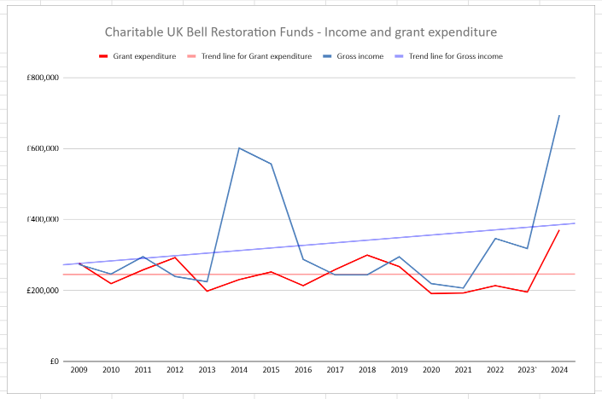
But ringers do this. According to figures published by the Charity Commission, over the last 15 years they continue to raise money for stand-alone BRF's faster than they are spending it. The amount raised by these BRF's has grown steadily from about £300k to about £400k per annum, thanks in certain years to large bequests, whilst the amount of grants paid out has remained relatively static at around £250k per annum, despite inflation.
So much money is now held in reserve that at current spending levels around 20 years of grants could be funded, without more income. In 1996 this was 5.3 years. Put another way £1 donated today will probably not be spent for 20 years, and rather than being invested for longer term capital growth, much of this is invested in short term deposit accounts.
Anything that gets members more involved and debating important issues such as this is welcome. Our ringing societies need to move forward and adapt, not remain firmly rooted in the past, just because that is what we do.
-
Absentee/Online votingHalf of the guild members in our district didn’t attend any of the 50 or so practices etc that we run during the year. — John Harrison
I was curious about what practices you are offering your members. However I see that the ODG website is down because of an attack by cyber criminals. Are you able to provide a summary? Recent decades have seen a massive gap open up between those at the top and the bottom of the ability spectrum. Could this and the death of the red zone be a factor in engagement?
Also the fact that many of the more experienced ringers are now in their 60's, 70's and 80's and no longer have the energy and enthusiasm that they once had? -
Absentee/Online votingWhat I am looking for are mechanisms in which we can break free from our current situation of pretty much one meeting per year where any 'decisions' can be made - these are usually restricted due to the running order to electing (or re-electing more often than not) people into positions for which the have varying degrees of enthusiasm and drive. — Fran Watkins
I think that you are focussing too much on a voting system, when what you need to think about is a consultation and engagement strategy with your membership. In a bottom up organisation, voting is the end of the process, not the beginning.
Several Guilds and Associations have been conducting reviews of how they operate and it would be worth looking at what they have done. For example, the Bedfordshire Association undertook a review process starting in 2022, with various surveys and workshops to consult with their membership, and with regular monthly update newsletters to keep members informed, ending up with them voting in a substantial change in their structure and rules at their AGM in 2024.
If you do something like this, people will come along in person, express their opinions and vote. You're never going to achieve anything as radical as what the Bedfordshire Association achieved through electronic voting.
https://www.bacbr.org.uk/association/association-review-information/ -
Absentee/Online votingI think this specific kind of consultation has a better chance of engagement than the general meeting which often has a running order of going through the motions and little to be discussed. — Lucy Chandhial
I agree. Sticking to the general running order is probably one of the main reasons why there is a lack of engagement by members and why many ringing organisations are finding difficulties filling vacant positions. Whilst it’s a source of comfort for some to have the consistency of doing the same thing decade after decade, it’s not going to set others alight.
We’ve been running three-day ringing courses for the last 50+ years, but what Lynn and Barry are doing in Cambridge, and what others are doing elsewhere, is a source of inspiration. One of our newer ringers attended two three-day courses last year and was concerned about the lack of 'rope time' they received. Two or three touches for their benefit each morning and afternoon did not result in them mastering what they came to learn.
Three-day courses teaching around 60 students at a time are not going to make a significant impact on delivering 10,000 new ringers over the next few years. Regular weekly sessions at a local level like those at St Clements are far easier to organise, less expensive to attend, and could engage a lot of new people But that is not what we always do, so is less likely to be considered at the typical general meeting.
Roger Booth

Start FollowingSend a Message
- Contact Us
- RingingForums Policy
- Terms of Service
- Useful Hints and Tips
- Sign In
- © 2026 Ringing Forums