-
 Roger Booth
135At the weekend I was with the training officer of one of our larger associations and I asked how many 'learn to ring' enquiries had they received through their association website. The answer was none!
Roger Booth
135At the weekend I was with the training officer of one of our larger associations and I asked how many 'learn to ring' enquiries had they received through their association website. The answer was none!
It does seem that although a lot of effort goes into recording peals and publishing all manner of peal statistics, very little research goes into analysing recruitment and training. My experience is also that guilds and associations are not very transparent about how many enquiries they receive, and very precious about where they are forwarded to. Nor is there any meaningful data on what the conversion rates are. Does your guild/association publish any such data in it's annual report? If so what are they?
If we are to recruit and train 10,000 additional ringers in the next four years, we need 40,000 enquiries as about half of them will not get as far a visiting a tower and having an initial lesson, and about half of those who have a first lesson will not be ringing two years later. That means about 10,000 initial enquires a year are needed. Divided by about 50 territorial guilds and associations = 200 per year for the average sized society. Do we get anything like that number?
Fifteen months ago the CCCBR wrote to all its affiliated guilds and associations, asking them to provide a list of contacts in their area to receive learn to ring requests that come through the new CCCBR recruitment portal. Will this work?
What have we learned since Ring for the King? https://bellringing.org/ring-for-the-king-survey/ -
 Lucy Chandhial
165I receive the learning to ring enquiries for the bellringing.London site and therefore receive enquiries mostly related to the Middlesex Association but sometimes beyond. I agree with your approximate stats on the number of enquiries which actually lead to someone who learns.
Lucy Chandhial
165I receive the learning to ring enquiries for the bellringing.London site and therefore receive enquiries mostly related to the Middlesex Association but sometimes beyond. I agree with your approximate stats on the number of enquiries which actually lead to someone who learns.
Last year we had 60 enquiries (43 in 2024 and 66 in 2023).
Alongside this I hear of many enquiries made within a specific church, from people who hear the bells whether church goers or not, and are drawn to ask about ringing.
The Recruitment and Development workgroup held a briefing on 8th Feb that shared a newcomer’s perspective on Association websites and how we could improve the learning to ring accessibility. The slides and recording are available here: R&D briefing slides for recruitment via websites
It is still obvious to me, from the enquiries I receive, that we don’t always have the teaching capacity to match the enquiries and that the Ring for the King style big uplift in recruits is hard to handle so a steady drip feed is easier to work with.
I’m sure the recruitment portal will help. But it still relies on local availability of teachers with time to commit so that enquiries are followed up and people are given their best chance to learn.
We will need more ringers to be willing to learn to teach handling. ART is willing to run the courses to support people to learn to teach but many people shy away from the time commitment or the responsibility / risk factor or both.
Associations could do a review of which towers are unable to teach new learners and try to address this as a fundamental key to building a band is being able to teach from scratch.
This is probably more important now than whether or not people get the chance to ring Bristol maximus or how many peals are rung but I agree that our Association Annual Report and committee meetings tend to focus more on the ‘elite’ end of ringing and less on ensuring we will have ringers in the future. -
 Mike Shelley
55Whilst stressing the need to focus attention on recruitment per se we also need to consider retention of individuals. Most social activities go through an inevitable change of participants over time, whether it's anything from bell-ringing to evening institute badminton. Groups that are unaware of that process and so fail to address the factors affecting retention of membership fail to be self-sustaining. Every university society loses a tranche of members each year but focusses heavily on the next year's student intake with a robust recruitment process. They have finite durations of membership and can turn a blind eye to the retention problem. However, most other groups, such as ringing bands and caving groups, have the opposite problem - if they wish to survive they must actively recruit enough to maintain at least an equilibrium in numbers, but if they fail to address why members lapse, members will keep leaving and recruitment of replacements becomes a permanent, major problem. There is a 'critical mass' situation - existing numbers and current activities must be tailored to sustain the interest of participants. Small groups of experienced participants, if they're indifferent to the needs of inexperienced beginners, will not retain the latter no matter how hard the group ostensibly recruits. There must be enough experienced people around who ARE aware of the needs, aspirations and interests of those beginners. We must be willing to pay attention to what the beginners are doing and what they want to do. If they don't want to ring a peal in two months, accept that, and find out what will sustain their interest for the next decade and work on providing that.
Mike Shelley
55Whilst stressing the need to focus attention on recruitment per se we also need to consider retention of individuals. Most social activities go through an inevitable change of participants over time, whether it's anything from bell-ringing to evening institute badminton. Groups that are unaware of that process and so fail to address the factors affecting retention of membership fail to be self-sustaining. Every university society loses a tranche of members each year but focusses heavily on the next year's student intake with a robust recruitment process. They have finite durations of membership and can turn a blind eye to the retention problem. However, most other groups, such as ringing bands and caving groups, have the opposite problem - if they wish to survive they must actively recruit enough to maintain at least an equilibrium in numbers, but if they fail to address why members lapse, members will keep leaving and recruitment of replacements becomes a permanent, major problem. There is a 'critical mass' situation - existing numbers and current activities must be tailored to sustain the interest of participants. Small groups of experienced participants, if they're indifferent to the needs of inexperienced beginners, will not retain the latter no matter how hard the group ostensibly recruits. There must be enough experienced people around who ARE aware of the needs, aspirations and interests of those beginners. We must be willing to pay attention to what the beginners are doing and what they want to do. If they don't want to ring a peal in two months, accept that, and find out what will sustain their interest for the next decade and work on providing that. -
 Robert Brown
27With the best will in the world initatives by the CCCBR and guilds and associations will fail if the frontline resources dont exist. There is a massive disconnect between the CCCBR , Guilds and Associations and the average parish band, where one exists. Reform was promised by the CCCBR it never came in any meaningful form. As others have said there are those that do and most effective initatives are locally based and those that talk a lot and pontificate. Sorry to be blunt but we have seen similar events produce little longterm uptake , ring for the king being an example , and to keep doing the same thing hoping for a different result is madness
Robert Brown
27With the best will in the world initatives by the CCCBR and guilds and associations will fail if the frontline resources dont exist. There is a massive disconnect between the CCCBR , Guilds and Associations and the average parish band, where one exists. Reform was promised by the CCCBR it never came in any meaningful form. As others have said there are those that do and most effective initatives are locally based and those that talk a lot and pontificate. Sorry to be blunt but we have seen similar events produce little longterm uptake , ring for the king being an example , and to keep doing the same thing hoping for a different result is madness -
Lucy Chandhial
165I think the CCCBR has learnt from the Ring for the King experience and decided to aim for a steady recruitment drive, locally led rather than event driven. The aim of the new portal is to give people a useful place to land if they Google (or ask Chat GPT, etc) about where they could learn to ring.
It is definitely true that without people willing to teach at a tower the band will not grow. I think most parish bands do know someone from their local Guild or Association who offers some kind of support or advice, even if it’s simply by joining in and ringing with them once a month, but people are unlikely to be pushy about ideas around recruitment and teaching because the time investment means people have to want to take it on.
What would you like the Association / Guild or CCCBR to do differently to encourage or support towers to recruit and teach effectively? -
Robert Brown
27As a former CC Rep and from yhst expierience I remain of the view that the whole organisation needs to slim down and stick to the things that no one else will or can do . Doves Database, Methods, promulgating information and good practicr and recording peals, basically an information exchange. In the current economic climate expensive get togethers shouldnt be part of the agenda, deal with it on Zoom or teams , one rep per guild , the rest made of people doing something . Cutting out large in person meetings would go a long way to save the planet. I could go on.
-
Roger Booth
135We seem to have deviated significantly from the point of my original question which was that a lot of effort goes into recording peals, but very little goes into analysing and learning about what is happening with recruitment and training, and what affiliated Guilds and Associations are actually doing on the ground to address the current demographic challenges? A planned national survey in 2015 was abandoned due to hostility from certain quarters, so it will be interesting to see how many get on board with ensuring a good response to this November's planned national ringing census.
The www.wearebelringing.org URL was set up two years ago for the Essex Jamboree and the 'recruitment portal' was supposed to be up and running soon afterwards. Looking at this year's CCCBR's meeting papers the Technology Workgroup's brief report talks of problems with resources getting the portal back on track, with an engagement portal planned to be deployed this summer. But summer will be over soon and I am not convinced. Also isn't this duplicating what ART has been doing since it was established following decisions made at the Council's 2017 AGM, with £20,000 of the Council's own money?
We seem to be going round in circles and getting nowhere. -
Lucy Chandhial
165My understanding is that the recruitment portal is being set up because ART are focusing on teaching people to teach so whilst they offer a page to help people find a teacher they can’t offer a complete service to find a place to learn to ring everywhere.
Some Association and Guild websites are more accessible than others for someone who knows very little about bellringing but might want to learn so the Portal should help but a lot people do go through a local site from a Google search (or from a social media post, etc).
Hopefully the census (survey) which seems to be planned for November will help us understand the number of towers where no one can teach. Although it looks like it’s focused on individual ringers saying what they have done in a week so it might not capture the teaching gaps.
In the Recruitment and Development workgroup we have focused on sharing ideas / materials / case studies with those who are interested (as individuals rather than Associations) but I get your point that we are not pushing Associations to assess their capabilities or analyse the towers which are at risk of losing their band through inactivity. -
 John Harrison
581help us understand the number of towers where no one can teach. Although it looks like it’s focused on individual ringers saying what they have done in a week so it might not capture the teaching gaps — Lucy Chandhial
John Harrison
581help us understand the number of towers where no one can teach. Although it looks like it’s focused on individual ringers saying what they have done in a week so it might not capture the teaching gaps — Lucy Chandhial
If you want to capture what people ‘can’ do then asking what they ‘did’ in one week isn’t the best way to do it. -
Lucy Chandhial
165This is true.
I think the Census is designed to be a moment in time but until we see the planned questions I don’t know what it will capture.
If it doesn’t cover this kind of capability question then maybe I can address that separately with the R&D workgroup via the Associations later in the year. -
John Harrison
581It would be a shame to miss the opportunity to capture capability. Currently the only data we have on teachers is from ART. There were lots of teachers before ART and we don't know how many are still active but have not gone down the ART route.
-
Lucy Chandhial
165I’ll see if I can find out who is organising the survey but as far as I know the workgroups are not being asked to give any input. I was part of the pilot for the last survey and gave input before and after that but I don’t know what’s happened since to change it into a census.
-
Roger Booth
135Currently the only data we have on teachers is from ART. — John Harrison
ART's Annual Reports are publicly available on the Charity Commission Website. The total number of delegates on its teacher training modules since the start in 2012 is 6,162. Of course many do not go on to become accredited, but ART had 811 accredited members at the end of 2025. In addition, these teachers have enrolled 11,029 new ringers on the Learning the Ropes scheme. Therefore a significant proportion of the currently estimated 30,000 ringers have either been taught by an ART member or attended an ART Module, especially when you consider that many ringers in each tower do not teach.
Since Ring for the King in 2023 when 471 people enrolled on Module 1 to learn to teach bell handling, there has been a steady decline to 401 in 2024 and 368 people in 2025 enrolling on this module. My concern is the saturation point. If Ringing 2030 is to be successful at the scale needed, take up needs to be turned round dramatically.
However, my experience as a Tutor on some of these modules is that delegates mirror the demographics of the ringing population, with many over 60, and coming because their existing tower captain is no longer able to ring. They are coming out of necessity and are not ideal trainee teacher material. This cannot be sustainable. The 1988 survey showed that the most successful tower captains were those in the 20-40 age group. Much more needs to be done with those aged 16+ in young ringers groups and university societies to get them involved with teaching. Many completing activities have young leaders schemes, why not ringing? -
Lucy Chandhial
165I think it is partly simply the demographic of ringing.
Let’s say 10% of ringers are willing to learn to teach and to teach (as a hopeful guess).
This is probably roughly consistent from age 18 to 70 because the general willingness to invest time to support others doesn’t significantly change with age.
If only 10% of ringers are under 30 and another 20% 30-50 (a guess) then a teaching module with ten people learning to teach will only have 1 under 30 and 2 30-50 year olds.
I don’t think there are more people willing to learn to teach in the older age groups as a proportion, just that there are more of them to start with.
A couple of older ringers have told me that they think the origin of today’s problem is the people who learnt in the 1970’s and made little effort to teach or recruit for their whole ringing career.
Now a reduced population of people under 50 is being expected to take more responsibility because otherwise there will be no one left in 20-30 years time.
But the proportion of ringers wiling to make it more than a hobby and to invest time to support others (whether that is teaching, running practices, organising district practices, etc) hasn’t really changed so a few people are being asked to take on everything.
I am wary of expecting more younger ringers to take on more because this could push some of them away from ringing at all. Some people really don’t want additional pressure to take responsibility when they are studying or starting a career or raising a family and some people will never take on responsibility.
I think we can make it easier for those who are willing to take on responsibility by having good structure, like the ART programme does, and be supportive that new leaders will do things their way (within reason) and share positive stories of young people who teach, lead, etc (which we do) but I think piling on the pressure that ‘saving’ bell ringing sits with young ringers is not helpful so there is a careful balance to be managed.
If a survey in 1988 found 20-40 year olds were the most successful tower captains could those 60-80 year olds still be the most successful tower captains? What makes you think it was their age that made them successful rather than something about cultural development in learning to relate to others which helped that generation be better leaders and would continue to be part of their leadership style as they got older?
Just thinking locally about my experience I don’t see an obvious link between age and tower Captain success (if successful means building a band, seeing ringers develop and ringers enjoying the regular practice so continuing as ringers).
Ultimately willing ringers in their 60’s will continue to be very useful in most towers as they are fit to teach, have time they are willing to invest and represent a significant proportion of all bell ringers (whether they learnt in their teens or on retirement). -
Roger Booth
135A couple of older ringers have told me that they think the origin of today’s problem is the people who learnt in the 1970’s and made little effort to teach or recruit for their whole ringing career. — Lucy Chandhial
If a survey in 1988 found 20-40 year olds were the most successful tower captains could those 60-80 year olds still be the most successful tower captains? — Lucy Chandhial
This seems to be conjecture. In my initial post I said that a lot of effort goes into recording peals and publishing all manner of peal statistics, but very little research goes into analysing recruitment and training.
With a few mouse clicks I can see that from around 1950 to 1990 around 550 people a year rang their first peal. Since then there has been a gradual decline and last year only 146 people rang their first peal. A total of 4,709 people rang one ore more peals in 1980 and that dropped to 2,124 in 2025. I can see everyone's names and with a few more clicks find out much more too. Similarly I can see the names of 16,955 people who rang one or more quarters in 2012 and 12,500 people in 2025. However we have no reliable metrics on the numbers of active teachers, or how many people they have taught to handle, and how many are still ringing after 1 year, 2 years and 5 years, etc.
Part of the problem is the quality of teaching. There are some excellent teachers out there, but many others struggle, and would welcome help and guidance. This has been recognised for decades. In the 1990's the Central Council launched the Management Teaching and Maintenance (MTM) course. There was also the Ringing Centres initiative.
The Council's Education Committee also proposed Certified Instructors and the establishment of an 'Instructor's Guild'. There were concerns that if introduced, churches and insurance companies might insist that ringing was only taught by certificated instructors and, where none were available, ringing would cease. At the 1999 AGM the following resolution was passed “The Council asks the Education Committee not to pursue the question of certification of instructors until the Central Council Instructors’ Guild is fully established nationally and is working well.”
Following this the Education Committee set up the Network for Ringing Training. Similar to today's Ringing Recruitment Network, so we are still going round in circles.
My concern is that the baby boomers have been teaching people in their own age group all the way through. There are less and less of them. Many are suffering burn out from years of teaching and many are less willing to go out in the evenings like they used to. A lot of the the over 60 ringers are also recent learners. Many do not have the reaction time to safely rescue people who lose control. Many come on ART Modules not because they are keen to learn to teach, but because there is no one left in their tower willing to take it on.
I don't see a problem with encouraging more young ringers to get involved with teaching. You only have to look at what the Cambridge and Birmingham University Societies have done to refresh their societies in recent years to see what an impact this has had. Also the Gloucester & Bristol DA took their youth team to man a mobile belfry at a Scout event in Cirencester a few weeks ago, having held a teacher training course for their youth group last year. Everyone had great fun and rather than push them away from ringing, it could have the opposite effect as they recruit and train other young people their own age and make new friends. Had a group of grandparents manned the belfry, it would not have had the same effect. Whilst the over 60's have their place, it needs everyone working together, a balanced approach and to recruit and teach smarter.
https://www.mobilebelfries.org/case-studies/ -
Lucy Chandhial
165I do agree with you that more statistics would be useful.
But I also think we need qualitative research / input as stats like the decline in peal ringing don’t answer the ‘why’ and, as others have considered in past discussions, it might be partly just that people don’t invest three hours of a day in one activity as much as they used to years ago.
I have no problem with encouraging young people to teach but I am wary of the weight of expectation on younger ringers. I know myself (at 50) that people suggest I could take on the roles which people in their 70’s are giving up but there are only so many responsibilities I can take on and for every 70-something wanting to retire from responsibility there is less than one ringer under 50 to take over and we shouldn’t expect every ringer under 50 to be willing to take on responsibilities within ringing because many (like many over 50 ringers) just want it to be a hobby which fits into their wider life.
I fully get that ringing is in a difficult position now, growing ringing at a time when many of the past teachers and helpers are retiring means we left it too late to make it easy. I think that’s why we need ringers of all ages to work together to support good quality recruitment and teaching to give new ringers the best possible opportunity to enjoy ringing and stick with it.
But, yes, more stats would help us understand where we are today and Associations should be talking about and interested in the recruitment patterns and the retention rates within their area as this is essential to the health of the ringing community in the coming years. -
 John de Overa
624We will need more ringers to be willing to learn to teach handling. ... Associations could do a review of which towers are unable to teach new learners and try to address this as a fundamental key to building a band is being able to teach from scratch. — Lucy Chandhial
John de Overa
624We will need more ringers to be willing to learn to teach handling. ... Associations could do a review of which towers are unable to teach new learners and try to address this as a fundamental key to building a band is being able to teach from scratch. — Lucy Chandhial
We've grown our band from scratch - from three ringers, two of whom have since "retired" to twelve ringers currently. That's been via a mix of new & returning ringers, but we have one ART M1 accredited teacher and a second going through the process. If you want towers to be sustainable, they need to be exactly that, which means being able to teach new starters themselves. So yes, I think you are dead right.
Just thinking locally about my experience I don’t see an obvious link between age and tower Captain success (if successful means building a band, seeing ringers develop and ringers enjoying the regular practice so continuing as ringers). — Lucy Chandhial
Ditto.
Ultimately willing ringers in their 60’s will continue to be very useful in most towers as they are fit to teach, have time they are willing to invest and represent a significant proportion of all bell ringers (whether they learnt in their teens or on retirement). — Lucy Chandhial
You mean we aren't all useless will-never-amount-to-anything wastes of space? :lol: People who start ringing have a huge range of innate ability and aspirations, irrespective of their age. I'm not saying age isn't a factor, but I think it's far less important than the ringing hierarchy's apparent obsession with it would suggest.
Many do not have the reaction time to safely rescue people who lose control. Many come on ART Modules not because they are keen to learn to teach, but because there is no one left in their tower willing to take it on. — Roger Booth
It's teaching people to ring a bell, not trapeze, anyone who can safely drive a car should have the necessary reaction times. I've seen some dreadful "experienced" teachers who's startle response is even more extreme than their pupil's when things go pear shaped. And in any case, we should be teaching people to self-rescue or at least "float to live" as a basic skill, not least because of the huge confidence boost it gives them.
With a few mouse clicks I can see that from around 1950 to 1990 around 550 people a year rang their first peal. Since then there has been a gradual decline and last year only 146 people rang their first peal. — Roger Booth
I can't think of a worse indicator of the overall health of ringing than an elite activity like peal ringing. It's always going to be a severely lagging indicator; even if grass roots ringing gets back into rude health, I'd expect peal numbers to continue falling for years - I for one never expect to (or want to) ring one. I don't think that peal ringing ever reflected the "bog standard" ringers most people have always been.
There's a dilemma here - it's long-standing elite ringers that have the experience, breadth of experience and interest which impels them to worry about the future of ringing. But they often have little in common with those of us at the bottom of the pile. As a result most of the effort seems to be focused on elite ringing, which is perfectly understandable. But I don't think that has ever been representative of the majority of people who ring, enjoy it, value the friendships and appreciate the excuse to go down the pub. -
 Graham John
365As a result most of the effort seems to be focused on elite ringing, which is perfectly understandable. — John de Overa
Graham John
365As a result most of the effort seems to be focused on elite ringing, which is perfectly understandable. — John de Overa
Most of whose effort is focused on elite ringing? Outside the College Youths, the Cumberlands, and the National 12‑Bell Contest organisers, very little organised effort is directed at so‑called “elite” ringing. What you mostly see is ringers who want to progress being willing to travel to find the opportunities they need for their own development. -
 Jonathan Frye
18people who ring, enjoy it, value the friendships and appreciate the excuse to go down the pub. — John de Overa
Jonathan Frye
18people who ring, enjoy it, value the friendships and appreciate the excuse to go down the pub. — John de Overa
I believe those are the same motivations for why many people ring peals. -
John de Overa
624very little organised effort is directed at so‑called “elite” ringing — Graham John
And even less is directed outside of it as far as I can tell, apart from ART.
I believe those are the same motivations for why many people ring peals. — Jonathan Frye
Indeed, my point is that the social side of ringing is important at all levels, and for some people that's more important than the ability to ring complicated stuff. -
Roger Booth
135I also think we need qualitative research / input as stats like the decline in peal ringing don’t answer the ‘why’ — Lucy Chandhial
There's plenty of data to demonstrate 'what' has been happening over the past few decades. I'm not sure that we're ever going to get a clear answer to 'why' as there are a lot of different factors at play, and ringers being ringers we're never going to agree. It's a bit like global warming and there are still quite a few deniers.
The important questions are 'what' needs to be done, 'how' we are going to do it and ''where' should we focus our efforts.
I am wary of the weight of expectation on younger ringers. — Lucy Chandhial
We could make a big impact by encouraging those in leadership positions to delegate far more. Many of the older tower captains and society officers try to do everything themselves. The job grows, they become a very difficult act to follow, and so stay in post. However the Sherborne Teaching Aids 'One per Learner' book and 'Bell Club' encourages new ringers to learn to conduct call changes, conduct a 120, help with steeplekeeping, and write an article etc. ART's 'Learning the Ropes' scheme and '50 Ringing Things Challenge' takes this even further forward.
If there was a change in culture, with far more delegation and many more people encouraged to contribute in small ways, starting like this, there would far less load on any one person's shoulders. Rather than assume anything, perhaps we could survey some younger ringers to find out whether they would welcome being more involved in some small way. I suspect that they would, and it would also contribute to their enjoyment of ringing.
Of course, some of the people currently in positions of authority will be afraid of letting go, and the new people will make mistakes. However the existing post holders need to remain in the background and provide encouragement and support when needed. Regular changes will then bring new life to towers and societies. -
Graham John
365Many of the older tower captains and society officers try to do everything themselves. — Roger Booth
Yes, the answer is actually very simple. Every ringer who has been ringing for say 3 years, and has become confident in their own ringing should be encouraged to teach handling to others. Not only does provide a much larger pool of teachers, these teachers can more easily remember the difficulties they experienced when learning. As they progress further themselves, they can continue to mentor those they have taught. The reality is that you don't need expert ringers to teach basic ringing, and we should set an expectation from the beginning that natural progression in ringing involves teaching others. -
John de Overa
624Every ringer who has been ringing for say 3 years, and has become confident in their own ringing should be encouraged to teach handling to others — Graham John
This, and everything else in your reply, exactly matches my experience. I learned to ring at a tower other than my home one, the TC / teacher there encouraged me to start helping her to teach others and eventually to go on the ART M1 course, which coincided with our rehang, the retirement of the old TC and the growth of the band. I've taught all the new starters at our tower, and the new TC is getting trained up as well. I think that's another important point - it isn't obligatory for the TC to do the basic teaching as well, it's a different skill set and a good TC may not necessarily be a good handling teacher.
You are right that you don't need to be an expert ringer to teach handling, however you do need to have confident handling yourself, for example ringing just one stroke with your "wrong" hand is not for everyone. Your observation about remembering your own difficulties is important as well, pointing out to people that it's not just them that has struggles seems to be helpful, particularly for adults.
Another common assumption seems to be that once people can handle a bell well enough to ring CC's and PH, handling training is over. I think that's wrong, mine certainly wasn't adequate to ring methods and from observation, I'm not alone. I run weekly 1 - 2 person simulator sessions for people in our tower to work on improving their handling and I'm now getting requests from a neighbouring association. I've been told "This is the first 1:1 tuition I've ever had" and the sessions seem to be effective - at the most recent one, the attendee had only ever rung PH on the treble "by bell number", at the end of the session they'd rung it on 2 & 3 as well, and were counting their place. Clearly that needs translating to ringing into "real" ringing but when it comes to basic skills, I do wonder if "on demand" help is more effective than annual ringing courses? -
John Harrison
581Sorry for coming to this late.
older ringers have told me that they think the origin of today’s problem is the people who learnt in the 1970’s and made little effort to teach or recruit for their whole ringing career — Lucy Chandhial
That's an interesting observation. I wonder if it has any substance or maybe it's just one generation blaming another. Certainly those of us who started in the 50s and 60s had a very different life experience growing up after the war and we had far more freedom than youngsters now which might have shaped our characters, but it seems a bit sweeping to heap the blame on those who came after us.
I'm not saying age isn't a factor, but I think it's far less important than the ringing hierarchy's apparent obsession with it would suggest. — John de Overa
I think 'obsession' is a bit strong. It seems ensible to focus attention where the biggest problems are. Currently it is much easier to recruit 50+ than to recruit youingsters so it's sensible to focus on getting more youngsters, especially since in ringing there is a strong correlation between leadership and high achievement with having started young.
It's teaching people to ring a bell, not trapeze, anyone who can safely drive a car should have the necessary reaction times. — John de Overa
It's about more than reaction times. To react effectively you need full confidence in your own ability to control the bell in extreme conditions, which as Ropger said, a lot of people don't.
We could make a big impact by encouraging those in leadership positions to delegate far more — Roger Booth
Agreed, but we should go beyond individual delegation and institutionalise the idea that it is normal for a band to have a team of several officers running things. We have Foreman (aka TC) and deputy, Ringing Master and deputy, Secretary, Treasurer and Steeplekeeper. As well as reducing individual load it means that collectively we can do more. And we are in a more robust position if one of the pieces is knocked off the board.
Another common assumption seems to be that once people can handle a bell well enough to ring CC's and PH, handling training is over. I think that's wrong — John de Overa
Absolutely. The skill needed for high speed formation cycling is way more nthan getting to the end of a straight street without falling off. And in any case 'well enough to ring' usually means 'well enough to struggle through' not 'well enough to ring confidently and accurately'. -
Lucy Chandhial
165Sorry, to be clear - In this it was people who learnt in the 70’s blaming their own generation, not people older than that blaming another generation! Effectively blaming themselves and their peers (mainly their peers) and not necessarily blaming but reflecting on the situation today with hindsight and recognising the gap which has grown gradually across the last 40-ish years.
[John Harrison][/older ringers have told me that they think the origin of today’s problem is the people who learnt in the 1970’s and made little effort to teach or recruit for their whole ringing career
— Lucy Chandhial
That's an interesting observation. I wonder if it has any substance or maybe it's just one generation blaming another. Certainly those of us who started in the 50s and 60s had a very different life experience growing up after the war and we had far more freedom than youngsters now which might have shaped our characters, but it seems a bit sweeping to heap the blame on those who came after us.] -
 Paul Wotton
32As someone who learnt in the 60s, what I would say is that hindsight is a wonderful thing. In my opinion it took a, not unnaturally, long time for a generation of ringers to wake up to changes in church attendance and social attitudes. These changes resulted in the 'report to the TC' order given to boy treble choir members when their voices broke not providing a steady flow of potential ringers for two reasons: 1) Far fewer ex-choir boys as church attendance dropped; 2) The 1960's cultural changes meant that young people were not simply going to follow orders. This left a marching time hole in ringers that eventually led to a shortage of good ringers willing to act as TCs and able to mentor the next generation. Hence ringing societies/associations needing to step up their efforts to provide the development environments needed to retain and grow ringers. When I learnt something that I remember local most TCs doing.
Paul Wotton
32As someone who learnt in the 60s, what I would say is that hindsight is a wonderful thing. In my opinion it took a, not unnaturally, long time for a generation of ringers to wake up to changes in church attendance and social attitudes. These changes resulted in the 'report to the TC' order given to boy treble choir members when their voices broke not providing a steady flow of potential ringers for two reasons: 1) Far fewer ex-choir boys as church attendance dropped; 2) The 1960's cultural changes meant that young people were not simply going to follow orders. This left a marching time hole in ringers that eventually led to a shortage of good ringers willing to act as TCs and able to mentor the next generation. Hence ringing societies/associations needing to step up their efforts to provide the development environments needed to retain and grow ringers. When I learnt something that I remember local most TCs doing.
Going back to Roger Booth's question at the start of this topic. The CCCBR's charitable purposes as agreed by its affiliated societies include: "using its efforts to foster the continuing recruitment and retention of ringers;". The new CCCBR Recruitment portal should make a contribution to recruitment by providing a route for enquiries from people who are not aware of their local, and where it exists almost certainly better, route into ringing. It's part, and only part, of meeting the purpose quoted above. If those recruits are to be retained and developed into the next generation of experienced ringers, any recruitment processing system needs to know how to steer potential recruits towards a sound training environment. If that information is provided across all ringing areas then the CCCBR recruitment portal will work as part of the wider recruitment and development environment that I would expect all ringers to contribute to. -
 David Smith
17An interesting example of things going well age-wise is Melbourne (the Australian one!) While many of the older ringers still contribute a lot in various leadership roles, their numbers are diminishing and the younger ringers (20s and early 30s) are ... I was going to say "taking over" but perhaps that's a slight exaggeration, and a better phrase would be "becoming much more involved in running towers and teaching new ringers". A recent ART M2C there at the annual festival had two attendees from Singapore (which is great for different reasons) and the rest were all 20-35 years old. It is hard (and potentially foolish) to generalise from one instance, but I think the things that contributed to this were
David Smith
17An interesting example of things going well age-wise is Melbourne (the Australian one!) While many of the older ringers still contribute a lot in various leadership roles, their numbers are diminishing and the younger ringers (20s and early 30s) are ... I was going to say "taking over" but perhaps that's a slight exaggeration, and a better phrase would be "becoming much more involved in running towers and teaching new ringers". A recent ART M2C there at the annual festival had two attendees from Singapore (which is great for different reasons) and the rest were all 20-35 years old. It is hard (and potentially foolish) to generalise from one instance, but I think the things that contributed to this were
1. there were a good number of younger ringers in the various towers in the first place
2. all ringers, male or female, young or old, have for some time been encouraged to become involved e.g. with calling
3. ANZAB runs courses at a variety of levels, and encourages (financially) people to travel to attend such events
4. and ANZAB has particularly encouraged younger ringers in recent years with training events aimed specifically at this young age group.
Some of this takes money, and it remains the case that Australian and New Zealand ringers are dumbfounded by the quantity of cash in England tied up in BRFs and the like (you have more than enough bells) but which is not made available for the more human side of ringing (training, recruitment etc) which is where the need lies. I know that efforts are underway and this is gradually changing but not fast enough. And the difficulty CC has had in tryng to get one pound of income per ringer is ludicrous - come on folks - if you've ever discussed this over a cup of coffee and a cake that would pay for your next decade of subs! -
Roger Booth
135it remains the case that Australian and New Zealand ringers are dumbfounded by the quantity of cash in England tied up in BRFs and the like (you have more than enough bells) but which is not made available for the more human side of ringing (training, recruitment etc) which is where the need lies. — David Smith
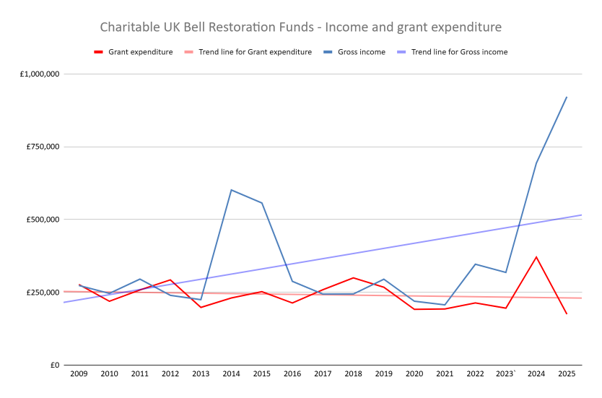
Agreed. Since 2009 when I was a Director of the Ringing Foundation, I have been keeping track, via the Charity Commission website, of income and expenditure into charitable BRF's and also those Societies where the whole society is a registered charity. It is evident that with current demographics a lot of money is being left to societies in bequests, and much more is probably on the way.
There are 30 Societies where just the BRF is a registered charity and so far 20 of these have submitted their annual return for 2025. These 20 raised £921k for their BRF's in 2025, much of it in the form of bequests. However the amount paid out in grants from the 30 with stand-alone BRF's has remained relatively static since 2019, so has fallen in real terms. The current average is around £250k per annum.
In addition to this the Suffolk Guild (where the whole society is a registered charity) received a bequest of £267k specifically for augmentations to 8 or more, and the CCCBR itself also received a £67k bequest specifically for bell work to bells in Bedford.
I am not saying that we should dictate where people leave their money to, that is their choice, but there is a need for a publicity campaign from the CCCBR so that people are able to make better informed choices.
At a time when the CCCBR's regular income is less than £40k per annum, and we have far more bells than ringers to ring them, does this make sense? How is a recruitment portal going to operate if secure funding is not available to pay someone to operate it and respond in a timely manner to enquiries? let alone all the other things that could be done with this surplus funding?
-
 Jason Carter
100Roger Booth said:
Jason Carter
100Roger Booth said:
Agreed. Since 2009 when I was a Director of the Ringing Foundation, I have been keeping track, via the Charity Commission website, of income and expenditure into charitable BRF's and also those Societies where the whole society is a registered charity. It is evident that with current demographics a lot of money is being left to societies in bequests, and much more is probably on the way.
Roger to save me reinventing the wheel would you be prepared to share this data with me please? -
Roger Booth
135would you be prepared to share this data with me please? — Jason Carter
I have given you (and anyone else interested) view only access to the spreadsheet with this link https://docs.google.com/spreadsheets/d/1ouvd87QC_NLNu-Pclb1IirDMspbpx2c_/edit?usp=sharing&ouid=107676497967833956904&rtpof=true&sd=true
The returns from each society published on the Charity Commission website is hyperlinked, so all you need to do is click on the hyperlink to find out more.
To be clear, I am not suggesting that we should dictate where people leave their money to, as that is their choice. Nor am I suggesting that the CCCBR should 'steal' the money raised by Guilds and Associations, but what I am suggesting is that Guilds and Associations should be thinking seriously about what they should be doing with all this money that is accumulating, and with more bequests in the pipeline, likely to accumulate even faster.
Converting to the whole society being a charity to provide greater flexibility, giving larger grants, widening the scope of what will be paid for, rejuvenating unwelcoming ringing chambers, setting up more teaching centres, there are all sorts of possibilites for worthwhile use of all this money which is already sitting there and slowly depreciating.
In 1996 there were 5.3 years worth of funds held by societies in reserve, without any more money coming in. Now many Guilds and Associations hold 10 or 15 years in reserve, sometimes more. What is also worrying is that whilst a small number of societies, notably Oxford and Coventry have money invested for long term returns, and I have no problem with this, a lot of societies have their most if not all their money held in short term deposit accounts, notably the CBF Church of England Board of Finance Deposit Fund, which is currently giving a competitive rate of interest at 3.93% AER. However over the last 10 years funds invested here would have grown by 21.24% whereas CPI inflation was 41.65% https://www.ccla.co.uk/documents/cbf-church-england-deposit-fund-fact-sheet/download?inline
Many ringers are pensioners, or saving for their retirement. I am sure that any IFA would not advise them to hold substantial funds, which are not required for some time, in a short term deposit account! -
Roger Booth
135It's not just the stand-alone BRF's. Even the societies where the whole society is a registered charity are accumulating funds faster than they spend them:
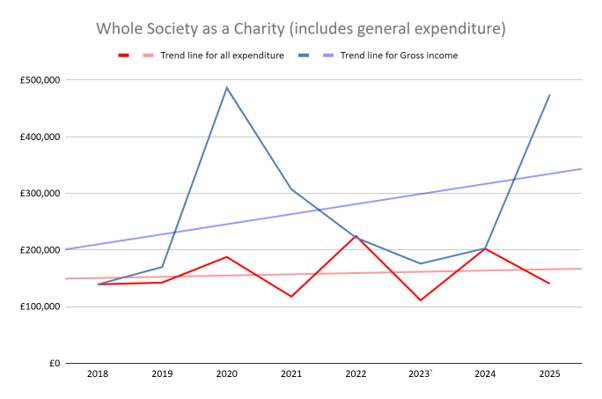
The large blip in 2020 is the Essex Association, who subsequently surveyed their members about what to do with the bequests, with some interesting results: https://eacr.org.uk/wp-content/uploads/2024/07/survey-feedback.pdf


Welcome to your Ringing Forums!
If you would like to join in the conversation, please register for an account.
You will only be able to post and/or comment once you have confirmed your email address and been approved by an Admin.
Categories
- BELL INSTALLATION & RESTORATION PROJECTS
- CALL CHANGES
- CCCBR Consultation
- EDUCATION AND TRAINING
- GENERAL
- MEMBERSHIP SOFTWARE
- MEMBERMOJO
- METHOD RINGING
- METHODS
- COMPOSITION
- CONDUCTING
- HANDBELL RINGING
- PUBLIC RELATIONS
- RECRUITMENT & RETENTION
- Ringing 2030
- RINGING SIMULATORS AND SOFTWARE
- RUNNING A TOWER
- TOWER MAINTENANCE
- YOUNG RINGERS
- DEVELOPMENT PATHWAYS
- SCHOOLS
- UNDER 18s RINGING
- UNIFORMED GROUPS
- UNIVERSITY RINGING
- YOUNG RINGERS HUB WEBSITE
- YOUTH LEADERS
More Discussions
- Contact Us
- RingingForums Policy
- Terms of Service
- Useful Hints and Tips
- Sign In
- © 2026 Ringing Forums